You hit the number. The spreadsheet finally says what you always told yourself it needed to say.
And then, nothing.
Not nothing in the sense of disaster. Nothing in the sense of anticlimax. The relief lasts a few days, maybe a few weeks, and then an uncomfortable question surfaces that no financial plan prepared you for: now what?
If you are living in that gap right now, here is the first thing worth knowing. It is not a flaw in your plan. It is one of the most well-documented patterns in the research on goal achievement, closely related to the disorientation described in Sudden Wealth Syndrome, and it happens to FIRE achievers, founders after an exit, traders after a career-defining year, and Olympic athletes standing on a podium, all for a related reason.
What Is the Arrival Fallacy?
The arrival fallacy is the mistaken belief that reaching a long-sought goal will produce lasting happiness.
Harvard positive-psychology lecturer Tal Ben-Shahar coined the term in his book Happier, drawing on his own experience as a competitive squash player. As Ness Labs explains in its breakdown of the concept, Ben-Shahar noticed that each championship win produced only brief happiness before he was already fixated on the next tournament. The win itself never delivered what the pursuit of it had promised.
The mechanism behind this has a name too: affective forecasting. Research by psychologists Timothy Wilson and Daniel Gilbert found that people reliably overestimate both the intensity and the duration of the emotional payoff from future events, a pattern often called the impact bias. You imagine hitting your number will feel like permanent relief. The research says it will feel like relief for a while, and then your baseline resets.
This connects directly to the classic 1978 study by Brickman, Coates, and Janoff-Bulman, which found that major lottery winners were not significantly happier than non-winners and, notably, took less pleasure in small everyday moments. The number changes your bank balance. It does not automatically change what your nervous system finds meaningful day to day, which is exactly why coaching this specific transition looks different from ordinary financial or retirement planning.
What Does Retirement Research Predict About Life After FI?
Retirement research is the closest existing parallel to hitting a FIRE number, and it predicts the identity gap almost exactly.
A 2025 qualitative study of 28 retirees in Northeast England identified identity, social interaction, and independence as the three core adjustment tasks of retirement, and found that people less than a year into retirement showed noticeably more acute identity detachment than those five or more years in. One participant put it plainly: “When you’ve got a job, you do define yourself a bit by your job.” Losing that role, even voluntarily and even with financial security intact, produced a real sense of what the researchers described as redundancy.
A related 2024 study published in the Journal of Occupational and Organizational Psychology found that how strongly someone still identifies as a “worker” versus a “retiree” predicts what they do next: worker-identified retirees tend to seek bridge employment, while retiree-identified people tend toward volunteering instead. Either way, the identity question, not the balance sheet, is what determines the next chapter.
What Is One More Year Syndrome?
One More Year syndrome is the well-documented pattern of delaying retirement or a planned exit past the point of genuine financial readiness, and identity, not caution, is usually the real driver.
Researchers at INSEAD studying early retirees found that many wrestle openly with “what do you do now?” and lack a satisfying way to describe themselves, unable to say “I’m an investor” with the same weight as “I’m a VP of Sales.” Their research on post-FI life identified three common paths: pursuing enjoyable projects without needing a grand purpose, exploring activities while still searching for meaning, or quietly decompressing into a lower-key life. Their conclusion, in their own words: “It is perfectly normal to discover that life post-financial freedom isn’t as happy as one might have expected it to be.”
A 2022 survey of over 11,000 North American adults by Edward Jones and Age Wave found that 59% of pre-retirees and retirees want to keep working in some capacity during retirement, whether part-time, cycling between work and leisure, or full-time. Work is not only income. It is structure, social contact, and a ready answer to the question “what do you do,” the same structure Kim Ann Curtin’s clients often lose overnight after years of high-stakes performance come to an end.
Is This Really Just a Money Problem?
No. The clearest proof that this is an identity problem, not a wealth problem, comes from a population with no financial variable at all: Olympic athletes.
Scientific American reported on what researchers call the post-Olympic blues: roughly 24% of Olympic and Paralympic athletes report psychological distress after the Games, and a University of Toronto study found 41.4% of Canadian national team athletes training for the 2020 Games reported depression, anxiety, or an eating disorder. USOPC lead sport psychologist Karen Cogan describes a predictable “period of letdown” immediately after competition, and Penn State researcher Andrew Friesen explains part of the mechanism directly: “When you have physically exhausted yourself, that means you don’t have capacity for those high, pleasant emotions like joy [and] excitement.”
Harvard Kennedy School professor Arthur C. Brooks makes the same point from a career angle rather than an athletic one. In his widely read Atlantic essay on professional decline, Brooks writes: “If you live to work, if your work is your life, or at least the source of your identity, proof of being fully alive is your professional ability and achievement. So when it declines, you are in the process of dying.” The number, the medal, the title, and the trade all function the same way psychologically. They become the identity, not just the achievement, and losing the pursuit feels like losing the self, a pattern that shows up constantly in the elite trader mindset.
What Does Your Number Actually Give You, and What Doesn’t It?
It gives you options. It does not automatically give you a reason to use them.
Self-determination theory, developed by psychologists Richard Ryan and Edward Deci, offers the clearest framework for what is missing when a number alone fails to deliver lasting fulfillment. Their research, summarized by the American Psychological Association, identifies three basic psychological needs that drive sustained well-being: autonomy, the sense of choosing your own behavior; competence, the sense of being effective at something that matters; and relatedness, a sense of genuine connection with others.
What “hitting your number” provides
What it does not automatically provide
Autonomy
Financial freedom to choose how you spend your time
A decision about what to actually choose, or the confidence to choose it without the old structure telling you what’s next
Competence
Proof you were effective at accumulating wealth or executing trades
A new arena to feel effective in, once the original pursuit is finished
Relatedness
The means to spend time with people you value
The professional relationships and daily social contact that a job or a trading floor provided by default
The number is not the enemy. It is simply a proxy, a means that can eventually fund autonomy, competence, and relatedness, but does not supply any of the three automatically the moment it is reached. Treating it as the finish line, rather than the funding round for the next chapter, is exactly what produces the identity gap. Where you land right now is worth naming honestly.
Self-Check: Which Stage Are You In Right Now?
Pick the statement that feels closest to true today.
What Actually Helps When You’ve Already Hit the Number?
Four things help: separating what you achieved from who you are, deliberately rebuilding autonomy, competence, and relatedness, planning the transition rather than just the change, and getting support built for this exact situation.
1. Separate “What I Achieved” From “Who I Am”
The number reflects what you achieved. It was never a description of who you are. Doing the identity work means building a new answer to “what do you do” that has nothing to do with the balance sheet, before you need one.
2. Deliberately Rebuild Autonomy, Competence, and Relatedness
Since the number itself supplies none of these three needs automatically, name what will. What will you choose to be effective at now. Who will you stay genuinely connected to, now that the old professional structure that guaranteed daily contact is gone. A clear self-assessment is often the fastest way to name this honestly rather than guessing.
3. Expect the Letdown, and Plan the Transition, Not Just the Change
Retirement researchers distinguish between the external change (the event itself) and the internal transition (the psychological letting go and reorientation that follows). Most people plan meticulously for the change and not at all for the transition. Building a personal plan, not just a financial one, before you hit the number is what separates people who land well from people stuck in One More Year syndrome for the wrong reasons. This is the same distinction behind what a genuinely professional mindset actually requires once the old scoreboard disappears.
4. Get Support Built for This Exact Transition
This identity work is not a symptom of anything wrong with you. It is the predictable next phase after any long, successful pursuit, whether that pursuit was a trading career, a company, or a FIRE number. Structured coaching built specifically for this transition, rather than generic financial or retirement planning, is what actually closes the gap between hitting the number and feeling like yourself on the other side of it. You can hear these themes explored further on The Wall Street Coach Podcast, review real client results, or start with the free tools and resources available now. Many people also ask whether coaching is actually worth it at this stage, which is worth answering honestly rather than assuming.
Frequently Asked Questions
What is the arrival fallacy?
The arrival fallacy, a term coined by Harvard lecturer Tal Ben-Shahar, is the mistaken belief that reaching a long-sought goal will produce lasting happiness. Research on affective forecasting shows people consistently overestimate how intense and how long the emotional payoff from achieving a goal will actually be.
Why don’t I feel happy after hitting my financial number?
Because the number is a proxy for autonomy, competence, and relatedness, the three psychological needs identified by self-determination theory as the actual drivers of sustained well-being. Hitting a number can fund those needs, but it does not automatically supply them.
What is One More Year syndrome?
One More Year syndrome describes the pattern of continuing to work well past the point of financial readiness for retirement or financial independence, driven largely by identity: work supplies structure, social contact, and a ready answer to what you do, none of which disappear when your number is reached.
Is this only a problem for wealthy people or retirees?
No. The same pattern shows up in populations with no financial variable at all. Research on Olympic athletes found that roughly 24% report psychological distress after the Games, driven by the same loss of pursuit and identity, not by money.
Does this happen after a business exit or a big trading year too?
Yes. Founders who sell a company lose the daily structure, team, and identity built around the business at the same moment the money arrives. Traders after a career-defining year often lose the routine and adrenaline that built their identity once the next trade becomes optional.
What actually helps once I’ve already hit my number and feel stuck?
Separating what you achieved from who you are, deliberately rebuilding autonomy, competence, and relatedness rather than assuming the number will supply them, and getting structured support built specifically for this identity transition rather than generic financial or retirement planning.
Is it normal to feel worse after hitting my number than before?
Yes. This is one of the most consistent findings across arrival-fallacy and retirement-identity research. The buildup toward a goal often provides more structure and motivation than the achievement itself, so a temporary dip in mood or direction immediately after is common, not a sign of ingratitude or failure.
How long does the identity gap after hitting my number usually last?
It varies, but research on retirement identity found that people less than a year into the transition showed noticeably more acute identity detachment than those five or more years in, suggesting the gap narrows with deliberate identity work over time rather than closing on its own by simply waiting.
Kim Ann Curtin is a wealth coach for sudden wealth, working with founders, traders, and executives whose bank balance changed faster than their sense of self. She is the author of Transforming Wall Street and host of The Wall Street Coach Podcast (110+ episodes). Work with a wealth coach for sudden wealth.
Sudden Wealth Syndrome: What It Is and How to Navigate It
Read time: ~9 minutes
Here is what nobody tells you before the wire transfer clears: the money arrives faster than you do.
The deal closes. The liquidity event hits your account. The trading account finally reflects the number you spent years chasing. And somewhere in the first few weeks after, a strange thing happens. Instead of relief, you feel unsteady. Instead of celebration, you feel guilty. Instead of freedom, you feel like you are impersonating someone else’s life.
That reaction has a name. It is called Sudden Wealth Syndrome, and if you are living through it right now, the first thing worth knowing is that it is not a personal failing. It is one of the most consistently documented psychological patterns in the research on financial windfalls, and it happens to founders after an exit, traders after a breakout year, executives after a buyout, and heirs after an inheritance, all for the same underlying reason.
What Is Sudden Wealth Syndrome?
Sudden Wealth Syndrome describes the disorientation, guilt, isolation, and decision paralysis that follow a rapid, significant increase in wealth.
Psychologist Stephen Goldbart and therapist Joan DiFuria coined the term in the late 1990s at the Money, Meaning & Choices Institute, after noticing a consistent pattern among their newly wealthy Bay Area clients. As WebMD reported in one of the earliest mainstream write-ups, Goldbart found that the newly affluent “feel cut off from their friends and family” and become “suspicious of investment counselors,” often withdrawing socially at the exact moment they have the resources to do almost anything they want.
It is not a clinical diagnosis. It will not appear in the DSM. It is a descriptive label for a real, observable transition, and Goldbart and DiFuria mapped it as four stages: Honeymoon, Wealth Acceptance, Identity Consolidation, and Stewardship. Most people who feel stuck are somewhere between the first two stages, still riding the initial adrenaline or starting to feel its cost, and have not yet done the identity work the third and fourth stages require. Kim Ann Curtin’s own coaching work centers on exactly this transition, treating it as a legitimate identity shift rather than a symptom to medicate away.
Cathy Seeber, a Certified Financial Transitionist who works with newly wealthy clients, put it plainly in an interview with CAPTRUST’s Vested Magazine: “Wealth creates emotion, and emotion drives decision-making. Acknowledging this is a first step to coping with sudden wealth.” Trauma-informed therapist Annie Wright frames the gap even more directly in her own clinical guide to the condition: “The deal may have closed on paper, but your mind, body, relationships, and sense of self may still be catching up.”
Is It True That 70% of Lottery Winners Go Bankrupt?
No. That statistic has been formally disavowed by the very organization most often credited with it, and the real research tells a far less dramatic story.
The 70% lottery figure traces back to an offhand comment at a 2001 financial-planning symposium. The National Endowment for Financial Education issued a formal statement disavowing it: “This statistic is not backed by research from NEFE, nor can it be confirmed by the organization.” Forbes covered the debunking in detail in 2023, tracing how a single unsupported claim became a permanent talking point.
The real, peer-reviewed research is more modest and more useful. A study published in the Review of Economics and Statistics tracked roughly 35,000 Florida lottery winners and found that larger cash windfalls made winners about 50% more likely to file for bankruptcy three to five years later than winners of smaller prizes, not because the money vanished, but because a lump sum without a framework for using it tends to postpone financial trouble rather than prevent it.
A similar myth circulates about business exits. The Exit Planning Institute’s 2023 National State of Owner Readiness Report attributes a claimed “75% of business owners regret selling within a year” to unpublished “PwC research” that cannot be independently located anywhere. What EPI’s own 1,162-owner survey actually found is quieter and, honestly, more useful: only 41% of business owners have a written personal plan for life after they sell, and 9% have no post-exit plan of any kind, financial or personal. The identity gap is not a rumor. It is measurable. It is just smaller and less dramatic than the viral number suggests.
Does Money Actually Make You Happier?
Yes, according to the most rigorous modern research, but life satisfaction and identity resolution are not the same thing, and that distinction is the whole story.
For decades, the go-to citation on windfall happiness was a small 1978 study by Philip Brickman and colleagues, which found that a sample of 22 lottery winners were not meaningfully happier than a comparison group, a finding often summarized as “money doesn’t buy happiness.”
More recent, larger, and longer-running research tells a more complete story. A study using German panel data covering 617 households found that windfalls did improve overall life satisfaction, contradicting Brickman’s null result. A Swedish study published as an NBER working paper tracked roughly 3,000 lottery winners for five to twenty-two years and found sustained increases in life satisfaction that did not fade over time.
Here is the part that matters most for anyone living through this right now: life satisfaction and identity resolution are not the same measurement. The Swedish research measured how people rated their lives overall. It did not measure whether they felt like themselves again, whether they had rebuilt a sense of purpose, or whether they had stopped feeling guilty about spending money they had earned. Satisfaction can rise while the identity question stays completely unanswered. That is the exact gap Sudden Wealth Syndrome describes, and it is the part financial planning alone was never built to close. It is also the exact question behind what happens after you hit the number you spent years chasing.
What Are the Signs of Sudden Wealth Syndrome?
Seven signs consistently show up across Goldbart and DiFuria’s original clinical observations, and noticing three or more of them in yourself is a meaningful signal, not a diagnosis.
Discomfort disclosing your wealth, even to close friends or family
Guilt instead of relief, particularly around spending on yourself
Decision paralysis, where obviously affordable purchases or choices feel impossible to act on
Social withdrawal, driven by a fear that relationships have changed or will change
Doubt that the money is real or deserved, sometimes called impostor experience
Obsessive monitoring of net worth, checking balances or valuations compulsively
A persistent fear of losing it, regardless of how much of a cushion actually exists
If three or more of these sound familiar, you are not malfunctioning. You are in the identity gap that every serious study on this topic describes. Check yourself against the full list below.
Self-Check: Are You Experiencing Sudden Wealth Syndrome?
Tick every sign that has been true for you in the last month, then see where you land.
Financial Advisor, Therapist, or Coach: Who Actually Solves This?
Most people who feel this way reach for one of two options, a financial advisor or a therapist, and both miss part of the problem. A third option, structured coaching, addresses the piece neither one covers.
What they address
What they miss
Financial advisor
Asset allocation, tax strategy, estate planning, protecting the capital
The identity work. A well-structured portfolio does not resolve guilt about spending or a lost sense of purpose.
Therapist
Underlying trauma, anxiety, depression, relationship strain when clinically significant
Performance and identity rebuilding. Clinical treatment is essential when there is real pathology, but Sudden Wealth Syndrome on its own is not a disorder to be treated. It is a transition to be navigated.
Coach
The identity reconstruction, decision-making frameworks, and stewardship habits that let a psychologically healthy person move from disorientation to a rebuilt sense of self and purpose
Clinical mental health treatment, which should always be handled by a licensed therapist when it is genuinely needed
This is precisely the gap in the existing content on this topic. Financial-advisory sites treat Sudden Wealth Syndrome as a planning problem. Clinical and trauma-therapy sites treat it as a mental health condition. Neither approach speaks to the person who is fundamentally fine and simply going through a real, well-documented identity transition that requires structure, not a diagnosis. Many people ask whether a coach is actually worth it for this kind of work, which is a fair question worth answering directly rather than assuming.
Does Sudden Wealth Syndrome Happen After a Business Exit or Trading Win Too?
Yes, and it often hits harder than a lottery windfall, because the money is not the only thing that changes.
Most of the research above uses lottery winners as the study population, because lottery windfalls are the easiest to measure cleanly. But the identity gap shows up just as sharply after a business exit or a breakout trading year. A founder who sells a company loses the daily structure, the team, the title, and the identity that came from building something, all at once, on the same closing date the money arrives. A trader who has a career-defining year often loses the adrenaline-driven routine that got them there and has to figure out who they are when the next trade is optional rather than necessary, a pattern closely related to the burnout that shows up after years of high-stakes performance. Writers covering this pattern describe it as a form of grief, not celebration, because something real was lost even as something valuable was gained.
This is the exact thesis behind my coaching work with people navigating sudden wealth: success changes faster than identity. The wire transfer, the closing documents, and the account balance move in an afternoon. The nervous system, the sense of purpose, and the answer to "who am I now" take considerably longer, and no financial plan was ever designed to answer that question. It is the same underlying pattern I see show up in the elite trader mindset and in the broader question of what a professional mindset actually requires once the old markers of success no longer apply.
What Actually Helps With Sudden Wealth Syndrome?
Four things help: naming your stage, separating your financial plan from your personal plan, replacing status with stewardship, and getting structured support built for this specific transition. Willpower and financial planning alone will not close the identity gap.
1. Name the Stage You're In
Using Goldbart and DiFuria's four-stage framework, honestly locate where you are: Honeymoon, Wealth Acceptance, Identity Consolidation, or Stewardship. Most people stuck in guilt or paralysis are still trying to skip from Honeymoon straight to Stewardship without doing the Identity Consolidation work in between. That stage cannot be skipped. It can only be delayed.
2. Separate the Financial Plan From the Personal Plan
The Exit Planning Institute's own data found that 41% of business owners have no written personal plan for life after their exit, even when their financial plan is airtight. Build both. The personal plan should answer what your week looks like, what gives you purpose without the old title, and what stewardship of this money actually means to you, not to anyone watching from outside. A structured self-assessment is often a useful starting point for naming where you actually stand.
3. Replace Status With Stewardship
The instinct after a windfall is often to prove the money changed something, a bigger house, a visible upgrade, a new identity performed for other people. The research on lasting life satisfaction points the opposite direction. Durable satisfaction comes from what you build and protect with the money over years, not from what it signals in the first six months.
4. Get Structured Support Built for This Specific Transition
A financial advisor protects the capital. A therapist treats clinical symptoms when they exist. What closes the identity gap itself is structured coaching built specifically around this transition, the kind of work that treats you as a high-performing person navigating a legitimate identity shift rather than a patient or a portfolio. You can read more about the results clients have reported from this kind of structured work, hear the same themes explored on The Wall Street Coach Podcast, or explore the free tools and resources available as a starting point.
Frequently Asked Questions
Is Sudden Wealth Syndrome a real medical diagnosis?
No. It is a descriptive term coined by psychologists Stephen Goldbart and Joan DiFuria in the late 1990s to describe a consistent pattern of guilt, isolation, and identity confusion after a rapid financial windfall. It does not appear in the DSM and is not a clinical disorder, though the emotional experience it describes is well documented and very real.
Is it true that 70% of lottery winners go bankrupt?
No. The National Endowment for Financial Education has formally disavowed this statistic, tracing it to an unsupported comment from a 2001 symposium. The actual peer-reviewed research, published in the Review of Economics and Statistics, found that larger lottery winners were about 50% more likely to file bankruptcy within three to five years than smaller winners, a real but far less dramatic effect.
Why do I feel guilty spending money I can obviously afford?
Guilt around spending is one of the seven core signs of Sudden Wealth Syndrome identified by Goldbart and DiFuria. It typically stems from an unresolved gap between your old financial identity and your new financial reality, and that gap closes through structured identity work, not through willpower or waiting it out.
Does having more money actually make people happier?
Recent long-term research, including a Swedish study tracking roughly 3,000 lottery winners for up to twenty-two years, found sustained increases in overall life satisfaction after a windfall. But life satisfaction and identity resolution are different measurements. Satisfaction can rise while a person still has no answer to who they are now or what their money is for.
Does Sudden Wealth Syndrome happen after a business sale or a big trading year, or only with lottery winnings?
It happens after any rapid, significant increase in wealth, including business exits, IPOs, inheritances, and breakout trading years. Business exits and trading windfalls often hit harder than lottery winnings because they also remove the daily structure, team, and professional identity the person built their sense of self around, not just their bank balance.
What actually helps, if not just a financial advisor?
A financial advisor protects and grows the capital. A therapist treats genuine clinical symptoms when they exist. Neither is built to rebuild your sense of identity and purpose after the transition. That work, naming your stage, separating your financial plan from your personal plan, and replacing status with stewardship, is best done with structured coaching designed specifically for this transition.
Does everyone who comes into wealth suddenly experience Sudden Wealth Syndrome?
No, and the severity varies widely based on how much of a person's identity was tied to their prior work, income, or social role. First-generation wealth, sudden trading success, and business exits tend to produce more acute versions of the pattern than gradual or expected windfalls, since there is less time to psychologically prepare.
How is Sudden Wealth Syndrome different from just being bad with money?
Sudden Wealth Syndrome is not about financial literacy or spending discipline. Many people who experience it manage their money conservatively and even excessively cautiously. The syndrome describes the emotional and identity disruption underneath the numbers, guilt, disorientation, fear, and a lost sense of self, regardless of how well the money itself is being managed.
Kim Ann Curtin is a wealth coach for sudden wealth, working with founders, traders, and executives whose bank balance changed faster than their sense of self. She is the author of Transforming Wall Street and host of The Wall Street Coach Podcast (110+ episodes). Work with a wealth coach for sudden wealth.
X Space with Anand Sanghvi (@sanglucci)- The Wall Street Coach – Episode #66
🎙️ Episode Title: Mindset, Markets & Moving Forward with Sang Lucci
In this episode, we sit down with Sang Lucci—a pro large-cap options and futures trader, hedge fund founder, and top trading educator—to dive deep into what it really takes to succeed in the markets. He shares his journey from Boston hustler to hedge fund manager, the crucial role mindset plays in trading, and how traders can refine their edge.
We also break down the FTX collapse, discussing its impact on traders, the risks of unregulated markets, and key lessons every investor should take away.
🔥 What You’ll Learn: ✅ Why mindset is the #1 factor in long-term trading success ✅ The biggest mistake traders make when defining their edge ✅ How Sang Lucci got caught in the FTX fallout—and what he learned from it ✅ What’s next for traders navigating today’s market landscape
🎧 Tune in now and level up your trading game!
🪄 Kim Ann Curtin helps traders and others end the cycle of self sabotage so they can improve their performance. 📈
📅 Join Kim’s LIVE Coaching sessions almost every Wednesday.
Elite Traders choose Opal for their best-in-class fee structure, locate inventory and bespoke nature. If you would like to minimize your costs and maximize your trading business, please reach out for more information.
2/5/25 – Live Coaching with Kim Ann Curtin
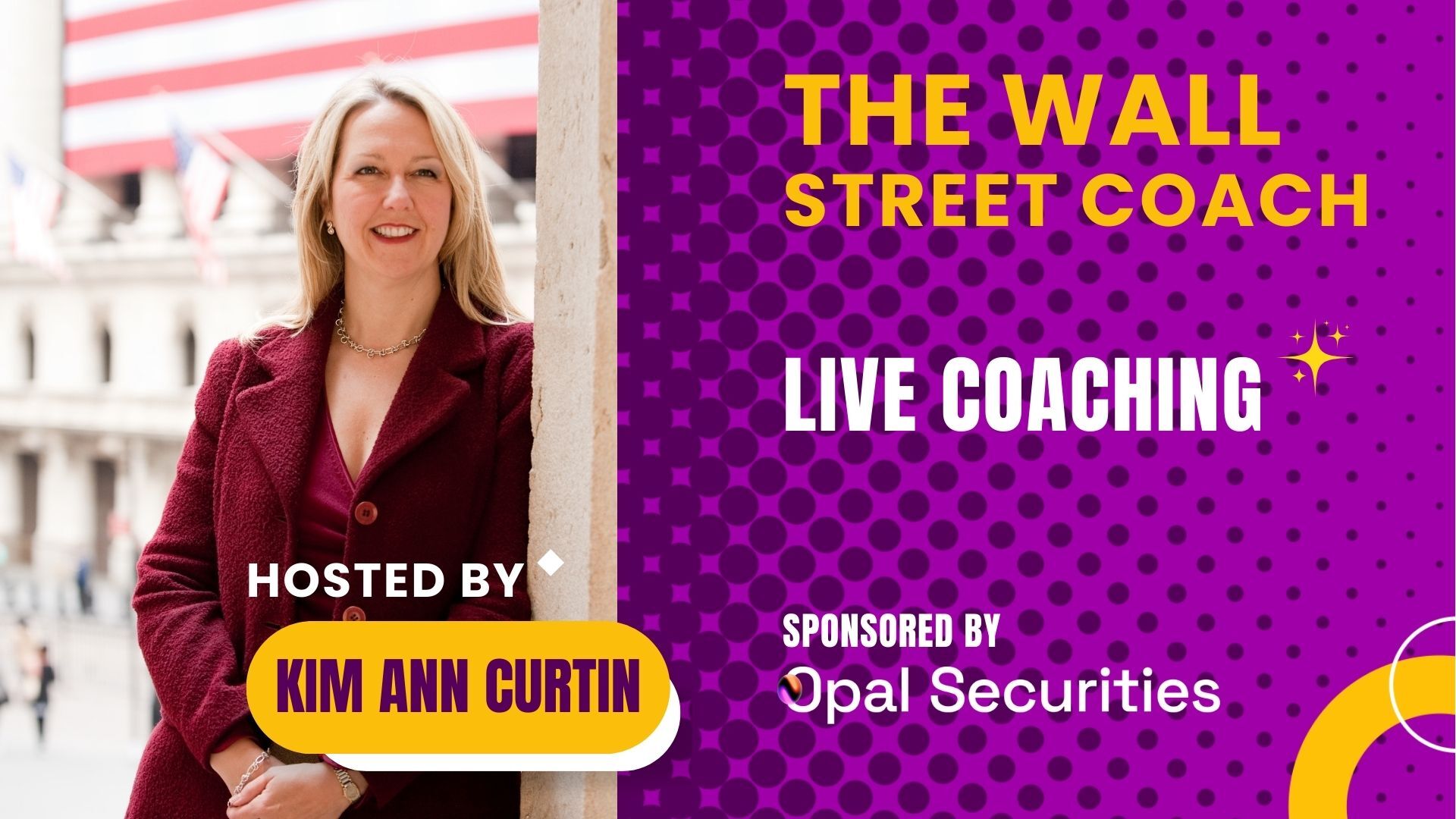
Live coaching with Kim Ann Curtin!
Sponsored by:
Elite Traders choose Opal for their best-in-class fee structure, locate inventory and bespoke nature. If you would like to minimize your costs and maximize your trading business, please reach out for more information.
1/29/25 – Live Coaching with Kim Ann Curtin
Live coaching with Kim Ann Curtin!
Sponsored by:
Elite Traders choose Opal for their best-in-class fee structure, locate inventory and bespoke nature. If you would like to minimize your costs and maximize your trading business, please reach out for more information.
1/22/25 – Live Coaching with Kim Ann Curtin
Live coaching with Kim Ann Curtin!
Sponsored by:
Elite Traders choose Opal for their best-in-class fee structure, locate inventory and bespoke nature. If you would like to minimize your costs and maximize your trading business, please reach out for more information.
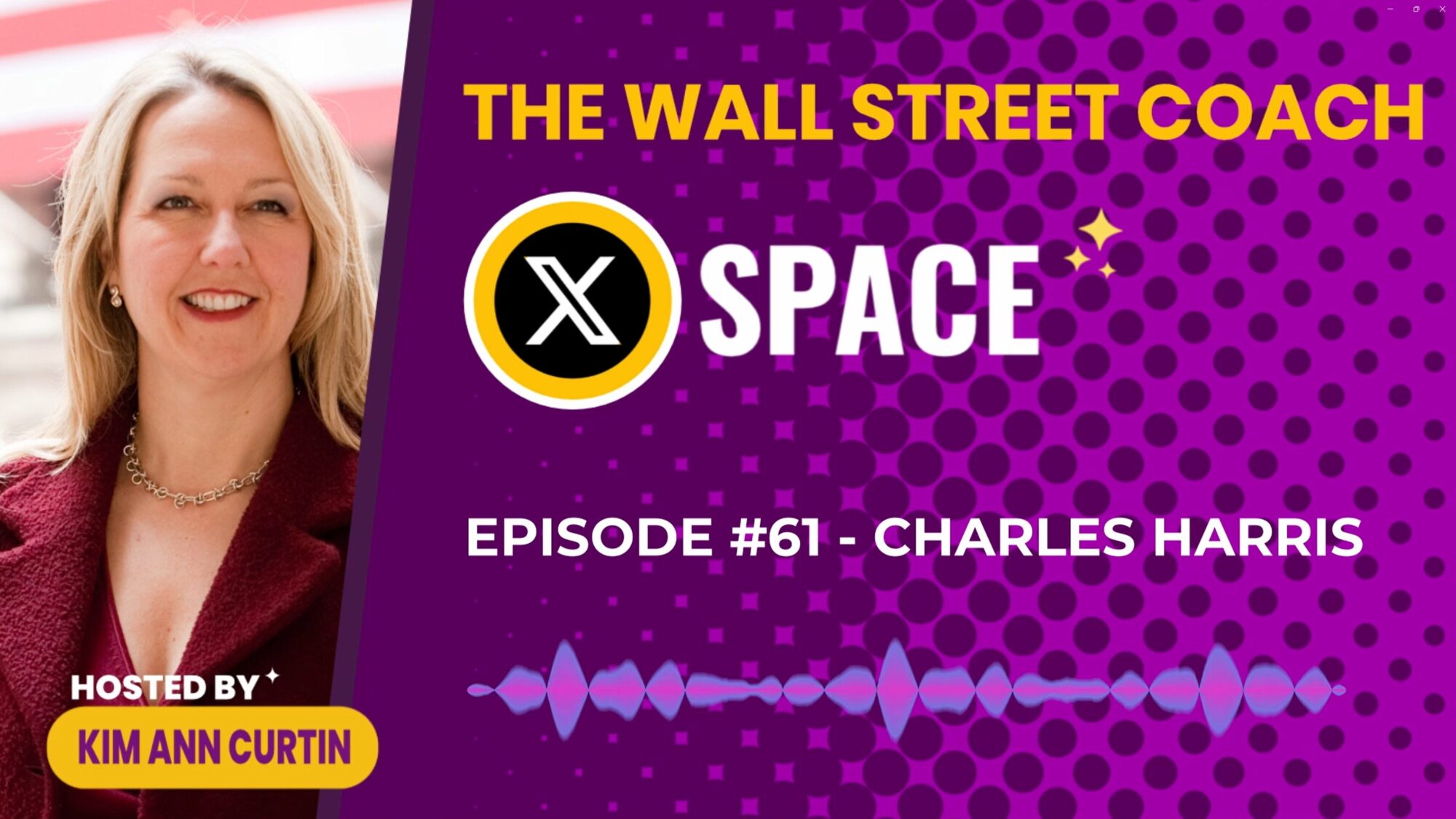
X Space with Charles Harris – The Wall Street Coach Podcast – Episode #61
Trade Less, Earn More
For years, Charles Harris traded as a swing trader, aiming to compound gains quickly. It was a rewarding career, but the grind of daily trading took a toll. Through the journey, he realized something powerful: the life-changing financial gains don’t come from constant activity—they come from identifying and holding onto “monster stocks.”
These rare opportunities—stocks with the potential for massive growth—can completely redefine your portfolio if approached correctly.
The key is recognizing these rare gems early, building conviction, and staying disciplined enough to hold onto a core position as the stock grows. You don’t need to win with hundreds of trades; you only need a few extraordinary winners.
Monster stocks don’t come around often, but when they do, they’re game-changers. The next time you spot one, focus, commit, and ride the wave—because that’s where fortunes are made.
Interested? Listen to learn more!
🪄 Kim Ann Curtin helps traders and others end the cycle of self sabotage so they can improve their performance. 📈
📅 Join Kim’s LIVE Coaching sessions almost every Wednesday.
Elite Traders choose Opal for their best-in-class fee structure, locate inventory and bespoke nature. If you would like to minimize your costs and maximize your trading business, please reach out for more information.
X Space with Jason Apollo Voss – The Wall Street Coach Podcast – Episode #34
The Power of Intuition in Investing: A Key to Navigating Uncertainty
When it comes to investing, intuition often plays a critical role—especially when data alone can’t answer key questions. While numbers, charts, and historical trends can give us a sense of what might happen, investing is inherently about the future. The challenge is that data can only show us past patterns, and what worked in the past isn’t always indicative of future success.
This is where intuition comes in. As a seasoned investor, Jason Apollo Voss found that honing intuition is just as important as analyzing data. Intuition helps answer questions that data simply can’t, like whether you can trust a company’s leadership or if a crisis will truly harm a business long-term. These are the types of intangible insights that set successful investors apart.
For Jason, intuition contributed about 30% to his success as a portfolio manager. In one instance, it helped him identify a company with strong potential, even when traditional metrics didn’t reveal the full picture.
Listen in to hear how blending data with intuition allows investors to anticipate future outcomes—putting them in a better position to make informed, forward-looking decisions.
🪄 Kim Ann Curtin helps traders and others end the cycle of self sabotage so they can improve their performance. 📈
📅 Join Kim’s LIVE Coaching sessions almost every Wednesday.
Elite Traders choose Opal for their best-in-class fee structure, locate inventory and bespoke nature. If you would like to minimize your costs and maximize your trading business, please reach out for more information.