How to Control Your Emotions While Trading (What Neuroscience Actually Says)

Most advice about controlling emotions while trading focuses on the wrong things.
“Follow your rules.” “Be disciplined.” “Trade like a robot.” These instructions assume that if you just try hard enough, the logical part of your brain will stay in charge. But there’s a specific point in every stressful trading session where that stops being true. And no amount of trying harder recovers it.
After 20 years coaching traders through live sessions, drawdowns, and the full spectrum of what markets do to the human nervous system, I’ve come to see emotional control not as a willpower problem but as a nervous system management problem. The distinction matters, because the solution is completely different.
One thing I tell every trader I work with early on: the way you react is not the enemy. It’s a protective mechanism. Your nervous system learned that reaction somewhere, for a reason. The problem isn’t that you feel fear or frustration or that urge to revenge trade. The problem is that you haven’t yet built the pause between the feeling and the action. That pause is what we’re building here.
Here’s what’s actually happening inside your brain during a losing trade, and what to do about it.
Key Takeaways
- Under high stress, neurochemicals impair the prefrontal cortex, the brain region responsible for trading discipline, while strengthening reactive, fear-driven circuits (Arnsten, Yale, Nature Reviews Neuroscience, 2009)
- When volunteers at Cambridge had their stress hormones raised for eight days, their willingness to take risk in a lab task dropped by 44% (read the study)
- Naming an emotion activates the prefrontal cortex and was linked to a calmer response in the brain’s alarm system in a UCLA study (Lieberman et al., UCLA, Psychological Science, 2007)
- In a month-long Stanford study, five minutes a day of cyclic sighing lifted mood more than the same time spent in mindfulness meditation (Balban et al., Stanford, Cell Reports Medicine, 2023)
Why “Just Control Yourself” Doesn’t Work
The prefrontal cortex (PFC) is the most evolved region of the human brain. It manages the capacities required for systematic trading: attention regulation, working memory, impulse control, and the ability to hold a plan in mind while the market moves against it.
The amygdala is older, much older. It scans for threat and reward, processes fear, and activates the body’s stress response. It evolved for a world where “loss” meant losing your life, not losing a position.
When a trade moves sharply against you, the amygdala reads financial loss as a survival threat. It signals the hypothalamus to release catecholamines, noradrenaline and dopamine, into the bloodstream. Research by Amy Arnsten at Yale, published in Nature Reviews Neuroscience (2009), found that at high concentrations, these stress chemicals impair the PFC’s regulatory capacity and strengthen amygdala-mediated fear responses simultaneously.
The PFC goes partially offline. The amygdala intensifies. And the trader, who may understand exactly what they should do, finds themselves unable to do it. Not because they lack discipline. Because the biological hardware for discipline has been chemically impaired.
This isn’t a character flaw. It’s a neurological state. Understanding that distinction is where real change in your trading actually begins.
According to Arnsten’s research at Yale, stress-induced impairment of prefrontal cortex function, driven by catecholamine release, reduces working memory, attention control, and impulse regulation simultaneously, which are the exact capacities required to execute a trading plan under pressure (Arnsten, Nature Reviews Neuroscience, 2009). This is why “just follow your rules” fails: the part of you that follows rules is one of the things stress wears down. This is the mechanism behind rule-breaking and emotional hijack, understanding it as a neurological event, not a character flaw, is the starting point for actually fixing it.
The Cortisol Trap: Why Extended Losing Streaks Are Physiologically Dangerous
There is a difference between acute stress and chronic stress, and for traders, that difference is massive. Acute cortisol from a single bad trade spikes and fades. Chronic cortisol from a prolonged drawdown is something else entirely. The physiology goes deeper than most traders realise, how sleep and cortisol affect emotional regulation covers the specific hormonal mechanisms that either support or undermine your ability to stay regulated during a session.
Research by Kandasamy and colleagues at Cambridge Judge Business School, published in PNAS (2014), built on an earlier finding that traders’ stress hormone levels climbed during a volatile stretch in the market. In the lab, they raised volunteers’ stress hormone levels by a similar amount for eight days. By the end, their willingness to take risk in a gambling task had dropped by 44%, and they gave more weight to small chances of losing. These were volunteers in a lab, not traders in a drawdown. Still, it matches what I hear from traders after a long losing stretch: everything starts to feel too risky.
This is what I mean when I tell traders: the losing streak doesn’t just hurt your PnL. It alters the nervous system you’re using to recover from it. When this pattern persists across weeks or months, it crosses into trading burnout and emotional exhaustion, a different problem with a different recovery protocol.
Here’s why that matters. During a prolonged drawdown, the period when your strategy most requires steady execution, your own endocrine system may be working against you, pushing you toward excessive caution at exactly the moment the market may be presenting genuine opportunity. It may be more than “feeling bad.” Your body may be changing how risky things feel.
In a Cambridge lab study, eight days of raised stress hormones cut volunteers’ willingness to take risk by 44% (read the study). If a long drawdown does something similar to a trader, trying harder may not be enough on its own. Settling your body comes first.

Why Willpower Runs Out by the Afternoon
Decision fatigue is the second biological failure mode, and it compounds everything cortisol has already done to your trading. Self-control isn’t a fixed capacity you either have or don’t.
Roy Baumeister and Kathleen Vohs did well-known work suggesting that self-control and decision-making get harder with repeated use, and that choosing may tire you more than simply thinking about options. Later attempts to repeat some of that work found smaller effects, so it’s still debated. Not deliberation, but choosing. Entry or not. Hold or exit. Scale in or wait.
For a day trader making 15–30 decisions per session, the cumulative cognitive load is significant. Whatever the cause, many traders with strong morning performance report their biggest mistakes later in the day, not because the market changed, but because their capacity to respond to it did.
This isn’t a moral failure. It’s a cognitive resource under strain. And knowing that gives you a practical lever to pull.
Four Techniques That Work With Your Biology
So what actually works? Not harder willpower, specific regulation strategies that operate at the biological level where the problem lives.
1. Affect Labeling: The Neuroscience Behind “Simply Notice”
One of the simplest things you can do is name what you feel.
Matthew Lieberman and colleagues at UCLA, in a study published in Psychological Science (2007) titled “Putting Feelings Into Words,” found that labeling an emotion activates the right ventrolateral prefrontal cortex (RVLPFC). This activation is inversely correlated with amygdala activity. It directly dampens the emotional alarm system.
In practical terms: when you feel the surge of fear or FOMO or frustration during a session, saying or writing “I notice I’m feeling FOMO right now” can help you get your thinking back online. It sounds soft. In my experience, it works.
This is the mechanism behind what Rick Carson calls “simply notice” in Taming Your Gremlin. I’ve been recommending that book to traders for years because Carson’s core insight fits what that study found: you don’t fight the gremlin. You notice it. You name it. “I notice the voice that says I have to get back in right now.” The naming creates a space between you and the voice. That space is where the decision lives.
The sequence I give traders in my coaching sessions: Notice. Name. Choose. When the emotion spikes, first notice it is happening (“something is happening here”). Then name it specifically (“this is FOMO” or “this is the urge to get the loss back”). Then choose your next action deliberately from that named state. It’s a short sequence. It doesn’t require silence or meditation. Two seconds to notice, name, and choose how to respond.
Other studies on pushing feelings down suggest it takes continuous effort and can leave you with less to think with. Naming the feeling seems to help it settle instead.
Labeling an emotion activates the right ventrolateral prefrontal cortex and directly reduces amygdala activity, the brain’s threat-detection center, in a small brain-imaging study at UCLA (read the study). Pushing the same emotion down, by contrast, tends to take effort you need for your trading.
2. Cyclic Sighing: The Fastest Physiological Reset Available
Many traders know they should “breathe” when stressed. The pattern you use may matter.
Research by Christina Balban and colleagues at Stanford University, published in Cell Reports Medicine (2023), asked 111 people to spend five minutes a day for a month on cyclic sighing, box breathing, fast breathing or mindfulness meditation. Cyclic sighing, a double inhale through the nose followed by a full, slow exhale through the mouth, lifted mood the most and slowed breathing at rest more than meditation did.
The mechanism: prolonged exhalation activates the parasympathetic nervous system by increasing vagal tone, which helps slow your heart rate and settle you. You don’t have to think your way calm. You breathe your way there.
For traders, this is a practical circuit breaker. After a stressful trade, before entering the next position, a few cyclic sighs can help you come down from the surge. It doesn’t require quiet. It doesn’t require closing the platform. It takes a minute or two and a willingness to prioritize state management over immediate re-entry.
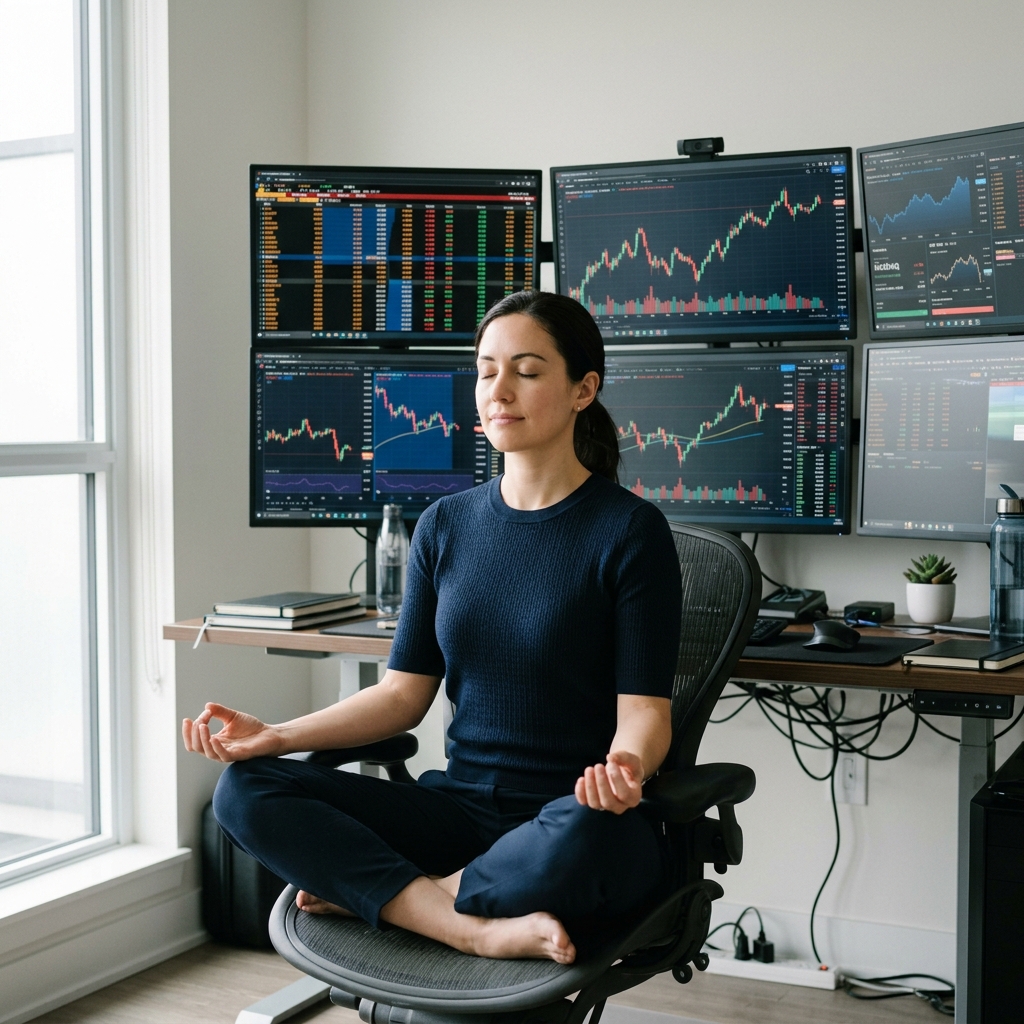
Cyclic sighing, a double inhale through the nose followed by a long exhale through the mouth, lifted mood more than box breathing or mindfulness meditation in a one-month study of 111 people at Stanford, practiced five minutes a day (Balban et al., Cell Reports Medicine, 2023). Even a few rounds before your next trade can help you settle.
3. Implementation Intentions: Pre-Decided Rules That Bypass the Amygdala
Standard goal-setting (“I will be disciplined today”) fails under stress because it requires the PFC to override the amygdala in real time, exactly when the PFC is most impaired. There’s a more reliable approach.
Research by Peter Gollwitzer on implementation intentions provides a better alternative: “if–then” plans that pre-decide a response to a specific situational trigger before the stress occurs.
“If I feel the urge to make it back, then I will stand up and take three slow breaths before I touch the keyboard.”
“If I miss a setup I was watching, then I will write ‘NEXT’ in my journal and move on.”
A review of 94 studies found that people who made if-then plans reached their goals noticeably more often than people who simply set the goal. The mechanism: they create what Gollwitzer calls “strategic automaticity”, pre-programming a behavior so that when the environmental cue appears, the response executes without requiring deliberate decision-making. You can be stirred up and the plan is still there, already made.
This is how you build discipline that survives the afternoon depletion problem. Not by trying harder, but by delegating the decision to the pre-session version of yourself who was still in PFC-dominant state.
4. The Pre-Mortem: 2 Minutes That Change What You See
Overconfidence and confirmation bias operate hardest during the entry phase, when a setup is forming and the brain is already pattern-matching to the expected outcome. The pre-mortem, developed by psychologist Gary Klein, interrupts this.
Before entering a high-conviction position, assume it has already failed. Not “what could go wrong?” but “it went wrong, why?” This mental shift from possibility to established fact produces a different quality of analysis.
Research by Mitchell, Russo, and Pennington in the Journal of Behavioral Decision Making (1989) found that prospective hindsight, mentally experiencing a future outcome as already having occurred, generates approximately 30% more explanations for why that outcome might happen, compared to standard forward-looking analysis. More failure reasons on the table means better-informed risk decisions before entry.
For trading: “This trade has already lost. Walk me through what happened.” Run it for 90 seconds. The hidden risks of the thesis become more visible, not because you know more, but because you’ve stepped outside the “greed state” that the entry creates.
Emotional Non-Resistance: The Practice Underneath the Techniques
The four techniques above are practical tools. But they rest on a more fundamental shift in how you relate to emotion itself.
Most traders operate from one of two modes: fighting emotions or being controlled by them. Neither produces consistent performance. The goal of what I teach as Emotional Non-Resistance is a third option: to feel the emotion fully without being driven by it. To notice the FOMO, the frustration, the excitement, and then make the decision from the observer’s position rather than from inside the emotional state.
Very often in live coaching, I hear traders describe revenge trading as the moment they “lost control.” But I want to reframe that. Revenge trades aren’t about the market. They’re about your nervous system trying to get the hit back. That’s not weakness, it’s a loop. And once you can see it as a loop, you can actually break it. The first step is always the same: notice it as it starts, not after it has finished.
This is different from suppression. Suppression says “don’t feel this.” Non-resistance says “feel it fully, and then act from your process.” The UCLA study points the same way: naming the emotion, which is an act of non-resistance, was linked to a calmer alarm response. Pushing it down takes effort and tends to keep it going.
Experienced traders don’t eliminate emotional responses. They learn to feel them without being driven by them. That’s the foundation of emotional discipline in trading: the emotion happens, the process still executes.
When Your Brain “Freezes” During a Trade
The freeze state is real, and it has a neurological basis. Under intense stress, the brain shifts into a state where the prefrontal cortex becomes less effective while threat-driven circuits dominate. The trader knows exactly what they should do. Cut the position. Follow the rule. Exit the trade. And yet they can’t act.
The trading plan is accessible intellectually, but not functionally, the brain systems required to execute it are temporarily impaired. Why does standard advice like “just follow your plan” fail here? Because accessing the plan requires the very brain function that’s under strain.
A more effective response uses the same tools already covered, in sequence:
- Physiological reset. Use cyclic sighing to reduce stress and stabilize the nervous system.
- Affect labeling. Name the state: “I notice I’m frozen right now.” This helps re-engage regulatory brain circuits and restore clarity.
- Pre-committed action. Rely on implementation intentions, a plan you made in advance, such as “If I notice I’m frozen, I take my hand off the mouse and exhale slowly.” It means you don’t have to decide in the moment.
- Feet on the floor. Feel your feet, soften your jaw, and let your shoulders drop. Your body settles first. Your thinking follows.
The freeze isn’t a lack of discipline. It’s a stress-driven shift in brain function that requires targeted regulation strategies, not more willpower.
Ready to Understand Your Specific Pattern?
The Trader Positioning Index (TPI) maps your psychological profile across 70+ indicators and helps you see where you may be leaking alpha.
Take the AssessmentFrequently Asked Questions
How Do Emotions Affect Trading Performance?
Emotions affect trading performance at the neurological level. Under financial stress, the brain’s threat-detection system increases catecholamines, especially norepinephrine, which impairs prefrontal cortex (PFC) function. This reduces working memory, attention control, and impulse regulation: the core capacities required to execute a trading plan.
Research by Amy Arnsten at Yale shows that high levels of these stress chemicals weaken prefrontal function while strengthening more reactive, fear-driven circuits (Arnsten, Nature Reviews Neuroscience, 2009). The result isn’t irrational behavior, it’s a shift in brain state where disciplined decision-making becomes significantly harder to access in the moment.
Why Does My Trading Discipline Fall Apart During a Losing Streak?
Sustained stress may change how risky things feel. In a Cambridge lab study, volunteers whose stress hormones were raised for eight days became 44% less willing to take risk in a gambling task. That was a lab study, not traders in a losing streak, but it matches what I hear from traders: after a long drawdown, everything feels too risky.
Knowing your body may be part of it makes it easier to respond with targeted strategies rather than self-blame.
What Is the Best Way to Control Emotions While Trading?
The most effective way is not suppression, but regulation. Here are four techniques I use with traders: (1) Affect labeling, naming the emotion to help the feeling settle (Lieberman, UCLA); (2) Cyclic sighing, extended exhales to activate the parasympathetic nervous system (Balban, Stanford); (3) Implementation intentions, predefined “if–then” rules that execute without real-time decision-making; (4) Pre-mortem analysis, generating failure scenarios before entry to reduce confirmation bias.
Is It Possible to Eliminate Emotions from Trading?
No, and I wouldn’t try. Your emotions are part of how you sense risk, reward and uncertainty. The goal isn’t to eliminate emotion, but to regulate it.
Studies on emotion suggest that pushing feelings down takes effort, while naming them helps them settle. In other words, suppression makes disciplined trading harder, not easier. The traders who perform consistently aren’t emotionless, they’ve learned to experience emotions without being driven by them.
Why Do Successful Morning Trading Sessions Fall Apart by the Afternoon?
A common reason is decision fatigue. Studies by Kathleen Vohs and colleagues suggested that making choice after choice wears down self-control, though later studies found the effect smaller than first thought. For active traders making dozens of decisions per session, it adds up. In my experience, the afternoon is when it gets harder to follow a trading plan, manage risk, and maintain emotional discipline, and it says more about how tired you are than about your character.
Kim Ann Curtin, known as The Wall Street Coach™, is a trading psychology and performance coach who works at the intersection of decision-making and the nervous system. For over 20 years, she has worked with institutional traders, hedge funds, and senior executives. Her clients include traders and executives affiliated with firms such as GIC, Morgan Stanley, Bank of America, King Street Capital, BC Partners, and Blackstone, along with leading trading communities including Investors Underground, Bear Bull Traders, True Trader, and StocksToTrade. She has also coached traders and leadership teams at CenterPoint Securities. She is the author of Transforming Wall Street and host of The Wall Street Coach Podcast (110+ episodes), focused on helping traders perform at a high level when it matters most.