What Makes an Elite Trader? (It’s Not Being Detached)

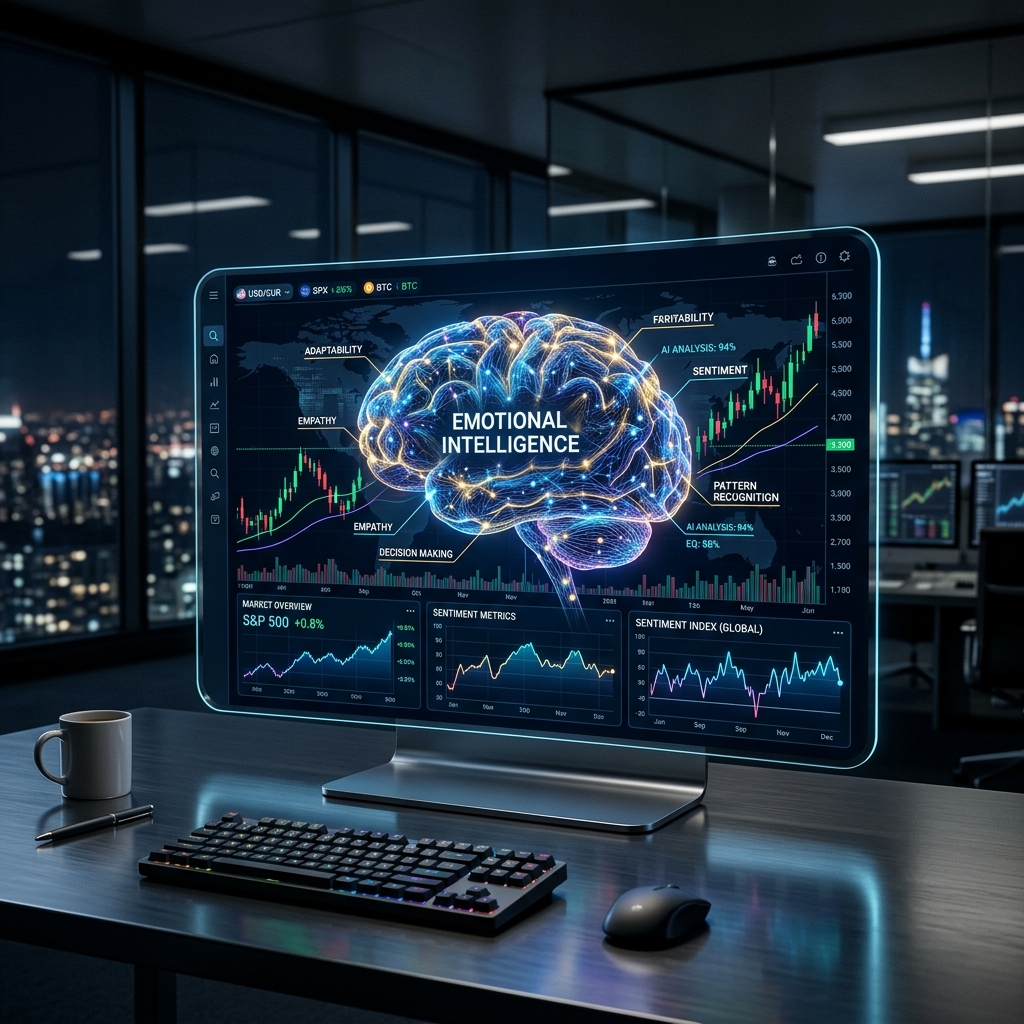
TL;DR: The popular image of the elite trader is a ruthless, emotionally detached operator running on pure discipline. One study points the other way: among 101 hedge fund managers, the ones rated most psychopathic earned lower returns than their peers. In my experience, elite trading takes emotional intelligence, not the absence of emotion. This guide covers what a few studies suggest and what 20 years of live coaching have shown me.

Let me start with the finding that surprises people most.
A 2017 study in Personality and Social Psychology Bulletin rated 101 hedge fund managers on psychopathic traits from videotaped interviews, then compared their funds’ returns from 2005 to 2015. The managers who scored highest, the “ruthless” type popular culture celebrates, trailed the average by about 0.88% a yearand the gap grew after adjusting for risk.
The emotionally detached, domineering trader makes a compelling character on television. In that study, at least, the profile went with worse returns.
What goes with better returns is more nuanced, and harder to build. After 20 years coaching traders and 110+ podcast conversations with professionals at every level, here’s what I’ve actually observed, and what a few studies suggest.
What Is the Elite Trader Mindset?
The elite trader mindset is the consistent application of self-awareness, process-focus, and psychological resilience to trading decisions under pressure. It is not a fixed personality type. It is a set of developed capacities that allow traders to execute correctly when markets are moving against them.
Those capacities are what trading psychology is actually built to develop, not to make you emotionless, but to make you less reactive and more deliberate under pressure.
Robert Quinn’s 2018 master’s thesis at Harvard Extension School looked at 71 mutual fund portfolio managers overseeing more than $157 billion. He found that managers in the top performance quartile scored higher on emotional intelligence (a mean of 70.07) than those in the bottom quartile (60.69).
It’s one thesis with a modest sample, so I hold it lightly. But it points the same way as what I see: emotional intelligence matters at the desk.
Why the Psychopathy Finding Matters
The psychopathy study matters because it challenges one of the most persistent myths in trading culture: that emotion is the enemy and its absence is the goal.
The researchers suggested why: people high in psychopathy tend to be impulsive and to ignore feedback, and investing well means adapting to information you didn’t predict.
I’ve seen this directly in 20 years of coaching. The traders who move from good to elite are not the ones who feel less. They are the ones who developed a sophisticated relationship with what they feel. Not suppressing it. Not being driven by it. Working with it as information. And I want to say this plainly, because it runs counter to a lot of what trading culture celebrates: some of the most emotionally numb traders I’ve worked with were the most dangerous ones to themselves. When you can’t feel when something is wrong with your risk, when you can’t register the discomfort of a position you don’t actually believe in, you miss a signal. The goal in my coaching is never to turn a feeling trader into a non-feeling trader. The goal is to develop the capacity to work with what you feel intelligently.
Jack Schwager confirmed this across the Market Wizards series: every trader profiled had their own methodology, their own risk framework, their own personality. No single emotional profile. But again and again, they had a deep awareness of their own psychology, an awareness of how they operated under pressure that most traders never develop.
The Deliberate Practice Distinction
Elite traders do not simply accumulate screentime. They practice deliberately.
That deliberate practice is the foundation of sustainable trading disciplinenot rules enforced by willpower, but responses trained into the system through repetition and feedback.
Research by K. Anders Ericsson on expert performance in high-stakes domains established that expertise is not the product of time on task but of structured, purposeful repetition designed to build increasingly complex mental representations. Applied to trading: the difference between a trader who has been trading for five years and an elite trader is not the five years. It is what they did with those five years.
A 2006 study by Cokely, Andersson, and Ericsson published in the Cognitive Science Society Proceedings, “The Enigma of Financial Expertise”, found that financial experts demonstrate a “very small but reliable superiority” in stock selection through extended deliberate practice and specialization. The market is deeply competitive. The edge is narrow. But it is real, and it is built through specific practice, not just experience.
What deliberate practice looks like for traders, based on Ericsson’s framework applied to the market context:
- Backtesting with psychological annotation: Not just outcome tracking, but tracking emotional state during specific types of setups
- Specific measurement: Quantifying the effect of every practice change on performance, not just reviewing P&L
- Concentration on limits: Repeatedly working the specific patterns where your performance degrades, not rehearsing what you already do well
- Journal depth: Sonnentag and Kleine (2000) at the University of Giessen studied deliberately-practicing insurance agents and found that deliberate practice time was significantly correlated with performance ratings, not years of experience, but structured practice time
The traders I’ve coached who made the most durable improvements were the ones who treated their development as a deliberate practice, not an accumulation of market exposure.
The other thing I notice in traders who accelerate fastest: they ask better questions. Not “Why did I lose?” but “What made me enter that?” Not “Will this strategy ever work?” but “What do I need to understand about my execution that I don’t yet know?” The traders I’ve coached who plateaued longest were, more often than not, the ones who stopped asking questions, who had decided they already knew roughly what the problem was. The traders who progressed fastest were genuinely curious. They asked, and then they actually listened to the answer, without defending what they thought they already knew.
How Do Elite Traders Relate to Being Wrong?
Elite traders treat being wrong as information. Most traders treat it as a verdict.
Carol Dweck’s research on growth vs. fixed mindset at Stanford provides the psychological framework. In her well-known studies, students with growth mindsets showed an upward performance trajectory over time while peers with fixed mindsets showed decline. After an eight-week intervention where students were taught that the brain changes with effort, they showed significantly greater improvement than control groups.
The trading translation is direct. A fixed-mindset trader views a losing trade as evidence about who they are: I’m undisciplined. I’m bad at this. I should have known better. A growth-mindset trader views the same trade as data: what does this loss tell me about this setup, this market condition, this emotional state I was in?
The first response contracts. The second opens the learning loop.
Studies of personality and investing point in a similar direction. People who are more conscientious tend to stick to plans, and people who react strongly to gains and losses tend to struggle more with composure. In my coaching, that’s exactly where the work usually is.
The Descent Is Not Optional
Every great trader’s story has a descent. Not a stumble. A real descent.
Jack Schwager described this on The Wall Street Coach Podcast: so many of the Market Wizards had a significant failure before their breakthrough. This pattern is not unique to trading.
A 2024 study by Lee and Park of 307 California heart surgeons over 15 years found that surgeons improved after their early failures, but only up to a point. After enough failures, they stopped learning from them. Surgeons with stronger training and specialization reached that point later.
Applied to trading: the capacity to keep learning from failure is not a given. It depends on the psychological infrastructure you have built. Traders who develop a framework for sense-making their failures, a journal practice, a coaching relationshipa community that reflects their patterns back to them, keep growing through the descent instead of hardening against it.
I teach this as the Hero’s Journey: a calling, a departure, a descent, and a return with wisdom. The descent is not a sign you don’t belong here. In the Market Wizards interviews and in 20 years of live coaching, it so often seems to be part of the path.
What Elite Traders Do That Developing Traders Avoid
Based on 20 years of coaching and the research above, here is what I observe consistently across traders who reach sustained elite performance:
- They journal with psychological depth. Not “bought at X, sold at Y.” They track the emotional state before the session, the specific moment a rule was broken, what they felt in the ten seconds before the break. Over months, this creates early-warning patterns that can be interrupted.
- They have a daily reset before and or after sessions. Some meditate. Some exercise. Some write. Some walk. Some play golf. Some have a side hustle. The specific practice varies. The function is consistent: establishing a clear distinction between personal identity and session performance before the first trade is placed.
- They engage with their losses instead of avoiding them. The impulse after a bad session is to close the journal, restart tomorrow, and not revisit what happened. Elite traders stay with the loss long enough to extract the data. Not to wallow. To learn.
- They work on their psychology consistently, not only during crises. The traders I’ve coached who made durable progress treated psychological development as an ongoing practice. Not the emergency lever they pulled when the account was in danger.
- They have accountability structures outside themselves. Lance Breitstein (Episode 56) and Mike Bellafiore (Episode 99) have both described, from different angles, how elite trading is almost always developed in community. The traders progressing fastest have someone to report to, someone who sees their process and can reflect their blind spots back to them.
The Mindfulness Nuance
I want to be direct about something a recent study raised, because it matters.
A 2025 working paper, “Mindfulness and Trading Decisions”randomly assigned participants to mindfulness training and then tested their trading in an experiment. The mindfulness-trained group did worse in fast, information-heavy conditions, especially after bad news, where the gap reached 35.4%. The authors suggest mindfulness may soften negative reactions, which can create a useful pause but may also slow you down when speed matters. It hasn’t been peer reviewed yet, and the participants were in an experiment rather than on a desk.
This matters because the blanket claim that “mindfulness makes you a better trader” is too simplistic. What mindfulness actually does, and what I teach through Rick Carson’s “simply notice” practice, is reduce impulsive, rule-breaking behavior and build the capacity to work with emotional states rather than be driven by them. For most traders, that’s the primary failure mode. But at the execution level, some degree of reactivity isn’t a flaw, it’s part of the skill set.
The goal is not to always be in observation mode. It is to develop range: the ability to slow down when discernment is required, and to act decisively when speed matters. That flexibility, rather than constant calm or constant intensity, is what defines high-level performance. It’s the state I see, consistently, in traders who sustain results over time.
How Do You Develop the Elite Trader Mindset?
The specific practices most consistently effective, based on the research and my coaching:
- The Power vs. Force daily question. From Dr. David Hawkins’ framework: ending each session by asking, Did I come from power today, or from force? Two sentences written. Done consistently over months, this builds a personal data set of your patterns more accurate than any performance review.
- The appreciative inquiry practice. Going through your journal and marking every trade where you executed fully in process, specifically mapping what you do well, in as much detail as you map what you do wrong. Most traders have no vocabulary for their strengths. That asymmetry is a performance problem.
- The “simply notice” practice. Rick Carson’s Taming Your Gremlin technique: noticing the inner critic, the impulse to revenge trade, the urge to hold past your stop, with curiosity, not judgment. “I notice I want to hold this. Interesting.” A small 2025 study found that a brief mindfulness exercise shifted traders’ hormone levels in a direction that went with better results in a trading task.
- Formal assessment. The Trader Check-In or full Trader Positioning Index (TPI) is the assessment I use with every client before we begin coaching. It maps your specific decision-making profile across 70+ indicators, creating a personalized roadmap, not a generic template.
- Structured coaching. The Optimized Trader Protocol is the 12-week one-on-one program where these practices are applied to your actual trading, session by session, specific to your profile.
Frequently Asked Questions
What makes an elite trader different from an average trader?
In one master’s thesis on 71 portfolio managers, the top performers scored higher on emotional intelligence. In my experience, elite traders don’t feel less. They have a more sophisticated relationship with what they feel. They treat losses as information, practice deliberately rather than just accumulating experience, and have accountability outside themselves.
Do you need to be emotionally detached to be a successful trader?
No. In a 2017 study of 101 hedge fund managers, the ones rated most psychopathic trailed their peers by about 0.88% a year. In my experience, elite trading takes emotional awareness, not detachment.
Is trading psychology more important than strategy?
Both are required, but they interact. Research on deliberate practice by Ericsson and colleagues shows that expertise is built through structured practice, which requires the psychological capacity to analyze failure honestly and adjust. A good strategy executed inconsistently will underperform a mediocre strategy executed consistently. In my experience, for many traders with a genuine edge, the limiting factor is psychological.
Can the elite trader mindset be developed?
Carol Dweck’s work on growth mindset, the surgeon study on learning from failure, and Ericsson’s work on deliberate practice all suggest these capacities can be learned. A small 2025 study even found hormone changes after a brief mindfulness exercise. In my coaching, I’ve seen traders build these capacities over time.
What does a trader’s journal actually track at the elite level?
Not just P&L. Elite traders track: emotional state before the session, specific moments when rules were broken, what they were feeling in the ten seconds before a rule break, and trades where they executed fully in process (not just mistakes). Research by Sonnentag and Kleine (2000) shows that deliberate practice time, structured, specific, measurement-focused, was more closely linked to performance than years of experience, in a study of insurance agents.
Kim Ann Curtin, known as The Wall Street Coach™, is a trading psychology and performance coach who works at the intersection of decision-making and the nervous system. For over 20 years, she has worked with institutional traders, hedge funds, and senior executives. Her clients include traders and executives affiliated with firms such as GIC, Morgan Stanley, Bank of America, King Street Capital, BC Partners, and Blackstone, along with leading trading communities including Investors Underground, Bear Bull Traders, True Trader, and StocksToTrade. She has also coached traders and leadership teams at CenterPoint Securities. She is the author of Transforming Wall Street and host of The Wall Street Coach Podcast (110+ episodes), focused on helping traders perform at a high level when it matters most.